Which price Maitaki uses for costing
The latest trusted purchase from any vendor, and what's skipped.
Also known as: current cost · latest cost · cost basis · last paid · average price · fifo · weighted average · price used · wrong cost · why this price
Every ingredient has one Current Price. It’s what your recipes cost with, what the Ingredients list shows, and what price movements are measured against. Maitaki works it out for you from your invoices, so there’s nothing to set by hand.
The rule
The current price is the most recent purchase, from any vendor, by invoice date, that Maitaki can trust. It isn’t an average. If you bought chicken from two vendors this month, the one on the later invoice wins.
A price that’s been set aside, for one of the reasons below, is passed over and the next most recent one is used.
What’s skipped
| Skipped | Why |
|---|---|
| A price that can’t convert to the pricing unit | The product has no pack, so a price per case can’t become a price per pound. It shows needs pack. See Set a product’s pack size. |
| A price the price check flagged | It shows check price until someone fixes the pack or confirms the price. See Handle “Price looks off”. |
| A price far out of line with recent ones | More than three times, or less than a third of, what you usually paid lately. It’s usually a misread, so it waits rather than move your costs. |
| Invoices you deleted, and copies set aside | A copy of an invoice you already have never counts twice. See Duplicate invoices. |
| Order confirmations | Only invoices count. See Why order confirmations don’t count. |
How the price per unit is worked out
Invoices bill by the case, bag or each. Maitaki turns that into a price per pricing unit using the product’s pack:
price ÷ (items in the pack × size of each item), converted to the ingredient’s pricing unit.
Example: a case of chicken breast costs $135.01 and holds 4 × 10 lb. That’s 40 lb, so the current price is $3.38 / lb. On the product’s page you’ll see both: $3.38 / lb, and underneath, $135.01 / case purchased.
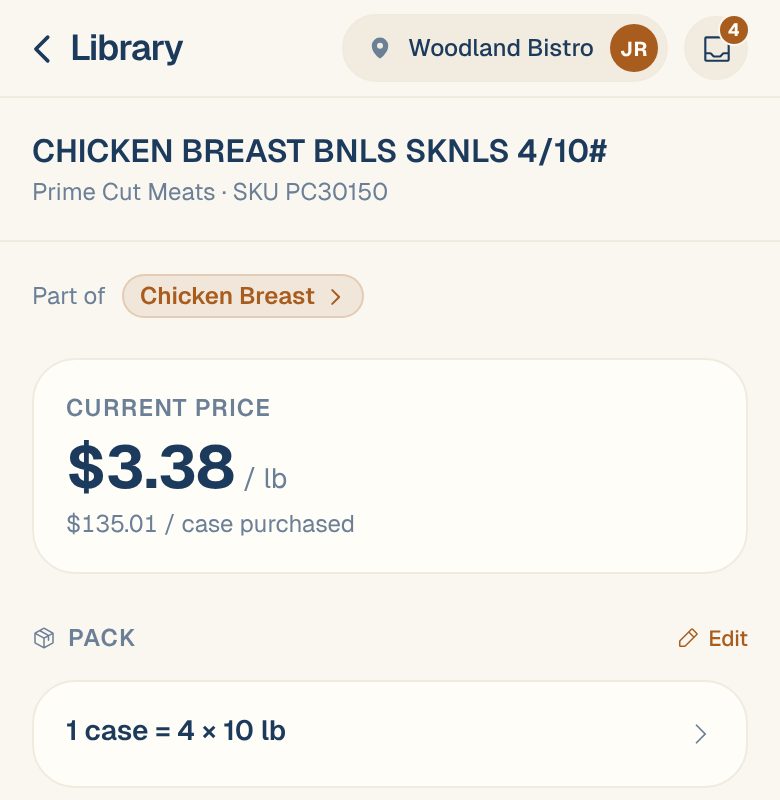
Meat and cheese billed by actual weight are already priced per pound, so they don’t need a pack. If an ingredient is priced per each but a recipe uses it by weight, or the other way round, see Cost by count with a piece weight.
Where you’ll see it
- Library → Ingredients: each row shows what you paid as billed, like $135.01/case, with the vendor and the price per unit underneath.
- The ingredient page: the Current Price card, with its date and invoice number. Tap the ingredient in the list to open it. See Current price and price history.
- Recipes: every recipe line costs at the current price. See Cost a recipe.
Common questions
Why isn't it using my cheapest vendor's price?
The current price is what you last paid, not the lowest price you’ve seen. The ingredient page lists each vendor with their own latest price, cheapest first, so you can compare. See Compare prices across vendors.
The price has a ~ in front of it.
The pack size is an estimate, such as a case of melons sold as 9–12 each, where Maitaki uses the middle of the range. Treat the price as approximate.
It says "Missing pack info — price can't convert".
None of this ingredient’s purchases could be converted, so the card shows the latest one as billed. Set the pack on the product marked needs pack and the price converts, past invoices included. See Set a product’s pack size.
I fixed a bad price. When do my recipes update?
You don’t need to do anything else. The current price, the price history and every recipe that uses the ingredient update together.